Artificial intelligence is no longer just a talking point for Silicon Valley or large international firms. It is very much a live issue across regulated financial services in Ireland.
The Central Bank of Ireland has described AI as one of the technologies with the greatest transformational potential for financial services and has been developing supervisory expectations for regulated firms using AI. Its revised Consumer Protection Code also explicitly says it is designed to reflect how financial services are now delivered.
That does not mean Irish financial advisers are under threat. In fact, the opposite may should to be true.
The more AI removes repetitive your basic admin tasks, routine drafting or organisation and time consuming background work, the more valuable the adviser becomes in the areas that clients genuinely care about, such as judgement, trust, reassurance, clarity and critically the professional advice they really want from you.
That is the real opportunity.
For Irish financial advisers and wealth planners, AI is not mainly a technology story. It is a productivity story and a service story. It has the potential to reduce friction in the working week, improve consistency, speed up internal tasks and free up more time for meaningful client work - advising clients.
Used properly, AI should not reduce the importance of the adviser. It should make it easier for advisers to spend more of their time being advisers and better advisers, armed with quicker access to research and results etc.
The real risk is not AI. It is wasted adviser time.
Most advisers do not spend every hour or anywhere near it on high value client conversations. Oh boy, would'nt that be so nice.
A large part of the week can be taken up by preparation, note taking, follow up, drafting, checking, organising information and managing the many tasks that seem to gather around the core client service. Much of this work is necessary. Much of it is also repetitive. Much of it makes you wonder how it is even part of the job you took on as an adviser.
That matters because every hour lost to process is an hour not spent helping your clients make better financial decisions.
This is where AI is most likely to make a meaningful difference first. Not by replacing the adviser, but by reducing the drag around the adviser.
If AI can help firms prepare faster, communicate more clearly, summarise information better and organise work more efficiently, then advisers gain something far more useful than automation for its own sake. They gain time, capacity and focus on what is truly important.
In a profession built on trust and client relationships, that is a serious advantage.
Advice is still human
Financial advice is not just the delivery of information. People can ask Google or ChatGPT for simple information as such.
Clients are not looking only for facts. They are looking for qualified interpretation of all the facts, perspective and the confidence that you can do this. They want someone who understands their particular circumstances, explains what matters, helps them weigh options and stays calm when life, markets or family priorities change. And who will review the plan on a regular basis as life moves on for the clients.
That human role does not disappear because technology improves. Far from it.
AI can summarise documents. It can assist with first drafts. It can help structure research or turn technical material into clearer language. But it does not and should not take responsibility for advice and it does not replace the relationship between adviser and client. The fear of AI is likely to push more people your direction to get professional human advice.
That relationship is built on trust, context and accountability.
Here in Ireland, that matters all the more because advice sits inside a regulated environment where consumer protection, suitability, transparency and proper oversight are central. The revised Consumer Protection Code, which took effect on 24 March 2026, is built around protecting customers’ interests and reflecting the reality of digital financial services.
So the future is not adviser versus machine, tool or artificial intelligence. It is adviser supported by better or faster systems.
Why this matters now in Ireland
There is a practical reason this conversation matters here and now.
Ireland’s overall population is ageing. CSO projections show the number of people aged 65 and over is set to exceed 1 million by 2030. That points to growing demand for retirement planning, investment guidance, income planning and clear financial decision making over the years ahead.
At the same time, advice already matters. Brokers Ireland’s 2023 Value of Advice research reported that respondents who had used financial advice were more likely to own a pension and had higher average pension values than those who had not sought advice. That does not prove advice caused the difference on its own, but it does underline the continuing importance of professional guidance in helping people engage with long term financial planning.
Against that backdrop, the firms that can serve clients well, communicate clearly and operate efficiently should be in a stronger position than firms weighed down by avoidable admin and fragmented workflows. Or conversely who try to use AI to replace the human in the loop in an advisory.
That is why AI matters. Not because it changes the need for advice, but because it may help firms deliver advice more effectively. Maybe you can look at working less hours in the week, like 40 instead of 60.
Where Irish advisers are most likely to see value first
The biggest gains are likely to come first from internal productivity rather than from flashy client facing tools.
The most practical early use cases are straightforward. Preparing for meetings. Summarising discussions. Capturing actions. Drafting follow up emails. Turning technical points into clearer plain English. Organising research. Creating first drafts of client updates, writing newsletters or internal documents. Standardising recurring tasks that currently rely on manual effort every time. Updating the CRM, posting on social media.
None of this removes the need for review or oversight. None of it removes professional responsibility. But it can reduce the amount of time lost to repetitive work and improve the consistency of what advice firms produce.
That matters because a well run financial advisory firm is judged by more than what happens in the meeting itself. It is judged by how prepared it is, how clearly it communicates, how reliably it follows through and how joined up the experience feels for the client. Once you gain the trust of the client, you want to ensure that you have as little friction as possible in the delivery of your service.
AI has the potential to strengthen those areas when it is used with care.
The fact that LIA is already offering AI-focused training for financial advisers and planners is a useful sign of where the profession is heading. Its course materials focus on practical uses of AI, compliance principles and ways to save time while improving client engagement. That feels like the right direction: practical, controlled and adviser-led. And it will give guidance for things like GDPR and cyber security, both of which become biger threats when you integrate AI in to the office.
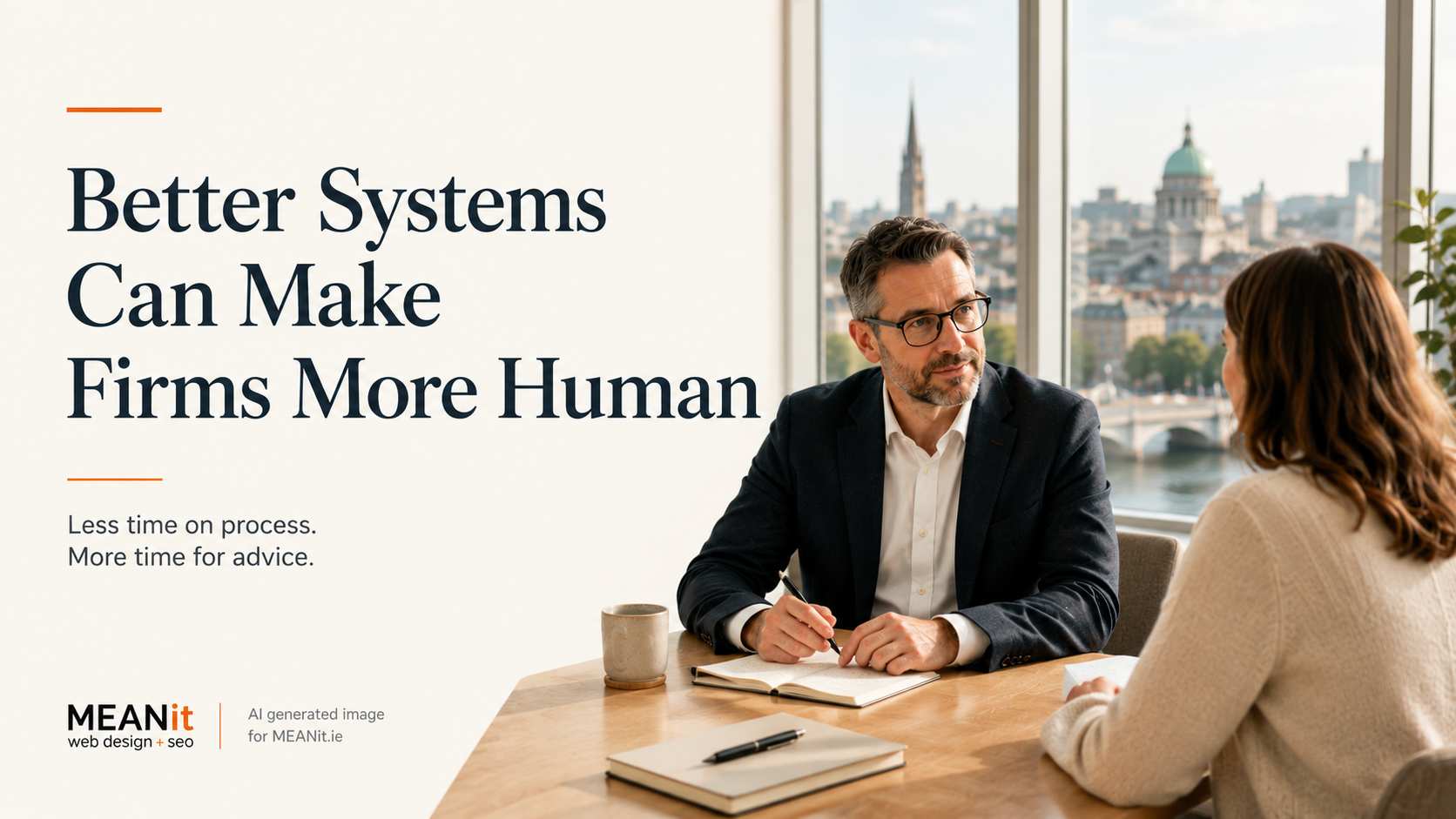
Better systems can make firms more human
There is a common fear that the more efficient a service becomes, the less personal it will feel.
In financial advice, the total reverse may be true.
If advisers spend less time on repetitive process, they have more time to explain, reassure, challenge assumptions, answer questions properly and deal with the real complexity in a client’s life. And more time to do the research and review the client’s specific situation.
That should increase adviser value, not reduce it.
The current danger in many professions is not that technology removes the human role. It is that too much highly skilled time is still being spent on work that does not require that skill. AI begins to change that equation.
It allows firms to reduce some of the drudgery around advice, which makes the advice itself more central.
The best advisers will not become less important in that world. They will become easier to distinguish from firms that remain slow, fragmented or overly dependent on manual process. Or the ones who become overly dependent on using 'tools' which can be off putting for their ideal clients. Most people who are your ideal clients, are not willing to simply engage with a digital dashboard and upload their documentation, then hope that everything is hunky dory. They are looking to pay a human to help with all of this, because it is so important to them to protect their assets and their future.
A more proactive model of service
One of the most interesting long term effects of AI may be a shift in how advisory value is delivered.
For many clients, the traditional model still feels episodic. There is a review, followed by a recommendation, an update and then a period of silence unless the client gets in touch or something significant changes.
That model is not necessarily broken, but it can feel reactive.
AI creates the possibility of something more responsive and better organised. Not a robotic substitute for personal service, but a more proactive practice model where advisers are supported by systems that make it easier to prepare, monitor, communicate and follow through.
In practical terms, that could mean firms identifying follow up needs more efficiently, responding faster to routine issues, keeping on top of client communications more consistently and reducing the gap between internal activity and visible client value.
Clients may never see most of the tools involved, they don’t need to. But they will feel the difference, if the service becomes more responsive, attentive, clearer and better organised. And that is what matters.
Sensible adoption matters more than hype
None of this means Irish firms should rush into AI carelessly.
In a profession built on trust, shortcuts are really dangerous. Sensitive client information needs to be handled properly. Outputs need review. Facts still need checking. Responsibility still sits with the firm and the adviser, not with the tool. We cannot blame AI for giving poor financial advice and it is not qualified or responsible.
That caution is not simply theoretical. Ireland’s Data Protection Commission has warned that where organisations use AI systems involving personal data, they need to understand what data is being used, how it is processed, where it goes and what risks arise. The DPC says a formal risk assessment should be considered where an organisation may be acting as a data controller in its use of AI. It also reminds people of GDPR protections around decisions based solely on automated processing. Even the best known AI frontier models say that they cannot guarantee that their platform 'cannot' be jailbroken. If Dario Amodei at Anthropic says that, then you surely cannot promise 100% security.
Alongside that, the EU AI Act is already applying in stages, with AI literacy provisions in force since February 2025 and broader obligations continuing to roll out through 2026 and beyond. For Irish advisory firms, that means the conversation is not only about productivity. It is also about governance, oversight and responsible use. Yeah, that does mean more work or studying just to keep up. More CPD for you. Or possibly just more specific and useful CPD.
So the right approach is measured and practical.
Start where the risk is lower and the value is obvious. Use AI to support internal productivity before trying to make it central to the client relationship. Put review processes in place. Be clear about what it is helping with and what still requires human judgement. Begin with any repetitive tasks and determine which could be done or part done using AI tools. By all means encourage your team members to embrace AI to make their job easier, with less grunt work. Tell them to consider if AI can help, before they start any task.
The firms that benefit most are unlikely to be the ones chasing headlines or the shortcuts. They are more likely to be the ones quietly improving how work gets done.
The future of advice is still human
The future of Irish financial advice firms is not a choice between people and technology.
It is about using technology to create more time for the parts of the profession that only people can do well.
Clients will still need trust. They will still need perspective. They will still need someone who can explain complexity, understand their personal context and help them make sound decisions with confidence. Those needs are not disappearing. If anything, they may become more important as the volume of information and noise continues to grow.
That is why AI is unlikely to replace good financial advisers.
What it may do is remove enough of the low value work around them to make their real value more visible and effective.
And for the Irish firms that use it well, that could be a very positive change indeed. Plus it could allow advisers enjoy work, so much more. Do what you started out to do, make the time to give good personal professional advice.
Takeaway: “Start small. Focus on low risk internal tasks. Keep human judgement at the centre of everything you do. Include your team members on this journey. The firms that learn to use AI well as a team may not become less personal, they may finally roll back the clock to have more time to be personal where it matters.”
FAQS on AI Will Not Replace Irish Financial Advisers
Will AI replace financial advisers in Ireland?
No, definitely not. AI will not replace financial advisers in Ireland, and the reasons are practical rather than sentimental. Regulated financial advice in Ireland requires a qualified professional who carries personal liability for every recommendation made. An algorithm cannot hold a QFA designation, cannot be held to the Consumer Protection Code and cannot be accountable to the Central Bank of Ireland. What AI does is take the repetitive work off the adviser's desk, running projections, pulling data, generating reports, so the adviser can spend more time on the things that actually matter to clients: understanding their situation, explaining their options and making a call under pressure. You are seeing new 'platforms' promising to make your life easire, but check with Brokers Ireland or your governing body to see if these tools are tested and approved, before using them. Avoid the initial low cost offers that will get you integrated in to someone elses platform, where you cannot control costs or guarantee data protection. Are you willing to upload personal information to one of these new platforms? Who is ultimately responsible for any data breach? Will you be covered for any reputational damage or loss?
How is AI changing financial advice in Ireland?
AI is changing how advisers work, not whether they are needed. The practical changes are already happening. AI tools are helping advisers model pension scenarios faster, draft suitability reports more efficiently and analyse client portfolios at a scale that was not possible before. For Irish financial advisers, that means less time on administrative tasks and more time in front of clients. The firms that are moving forward are the ones using these tools to sharpen their service, not the ones waiting to see what happens.
Can AI give regulated financial advice in Ireland?
No, simply no. Regulated financial advice in Ireland must be provided by an authorised person under the Investment Intermediaries Act 1995 and the Consumer Protection Code. AI tools can provide general information, run calculations and support an adviser's work. They cannot provide personal financial advice, hold a licence from the Central Bank of Ireland or bear the legal responsibility that comes with a formal recommendation. If you receive financial advice in Ireland, it should come from a qualified, regulated professional, not a chatbot or AI tool like Google Gemini or Claude.
What does AI mean for financial advisers who want to grow their client base?
It means the gap between good advisers and average ones is about to get wider. Advisers who use AI to work faster and more thoroughly will have more time for clients, more capacity to take on new business and better data to back their recommendations. Advisers who ignore it will be slower, more expensive to run and easier to lose to a competitor who has already made the shift. From a business development perspective, AI is not a threat to an adviser's client base. It is a tool for growing it, if used properly. Again, do not get overly dependent on any AI tool or platform. And protect your client data,because you were entrusted with it and are responsible for its protection - no presure.
Should Irish financial advisers be worried about AI?
The short answer is no, but they should be paying very close attention. The advisers most at risk are not the ones being replaced by AI. They are the ones being replaced by other advisers who use AI better than they do. If your firm is still spending half the week on admin that a well-configured AI tool could handle in an hour, that is a problem worth addressing. The adviser who shows up to a client meeting having already analysed their full financial picture, modelled three scenarios and prepared a plain English summary will always win more trust than one who arrives with a clipboard and a brochure, trying to wing it. Bear in mind that any savvy potential new clients are already coming with their initial research done. Much like you having an ailment, where you check with Doctor ChatGPT before you make an appointment with your own GP. We have all done it at this stage. And I bet your GP is not worried about AI putting out of a job.
People Also Ask
How do I get more ideal clients as a financial adviser in Ireland?
Most financial advisers in Ireland rely on referrals, but that only takes you so far. A well-structured website with clear messaging, strong Google rankings and regular content showing your expertise is how advisers attract their ideal clients they have never met. Our post at Website design for financial advisers explains what works and what does not.
What is SEO and why does it matter for financial advisers?
SEO, or Search Engine Optimisation, is the process of making your website rank higher in Google when potential clients search for the services you offer. For a financial adviser, that means turning up when someone searches "financial advisers in Swords", "Wealth planners in Meath", "Mortgage advisers in west dublin" or "pension advice professionals in Dundalk" rather than sitting on page three unseen. What is SEO is a long post that covers the basics in plain English.
Does a financial adviser need a new website or is SEO enough?
That depends on your current site. If it loads slowly, is not mobile friendly or has not been updated in a few years, no amount of SEO will fix what is fundamentally a conversion problem. The better question is whether the site you have is doing its job. Website costs in Ireland gives a realistic picture of what a proper redesign involves.
What kind of digital marketing actually works for financial services firms in Ireland?
For most financial firms, the highest return activities are organic search, Google Business Profile and a content strategy that answers the questions clients are already typing into Google. Paid ads can work but they are expensive in financial services. Building authority through consistent, well-optimised content and a clean technical setup tends to outperform short term spend. MEANit's SEO service for Dublin businesses sets out how that works in practice.
How long does SEO take to produce results for a financial adviser?
Realistic timelines for a professional services firm starting from scratch are three to six months to see meaningful movement and six to twelve months to see consistent qualified enquiries. There are no shortcuts that hold. What matters is that the work is done properly from the start: technical foundations, content that answers real questions and a Google Business Profile that is fully built out. Contact MEANit if you want a straightforward assessment of where your site stands.