We hope you enjoy reading the MEANit blog with all the guides and tips. If you want our team to help with your web presence click here

The articles here will give you everything you need to plan, design, develop, market and maintain your website, if you have the time required – Enjoy.

Google AI Mode is live in Ireland

by | Last updated: Nov 17, 2025

How does this affect professional services firms in Ireland?

For construction, legal and financial firms: Your content may be summarised by Google without a visitor going to your website You may miss out on leads and engagement that would previously have come from a click. Local SEO, branded searches and your own human expertise now matter more than ever, so do add some opinion and original content.
In the first three months of 2026 over 1.5 billion monthly users started seeing AI Overviews.  It does mean that people are getting answers without clicking through to the website that created the answer. 58% of users do not click through to a website. These overviews appear in over 50% of query results.

Robot hand holding smartphone with analytics dashboard showing AI Mode is live in Ireland by MEANit Web Design & SEO Agency

Google AI Mode is live for searchers in Ireland.

It reduces Organic Traffic by 60% as it presents a concise answer first, then invites follow up questions and shows links to sources. This change affects how people search for and choose service providers. It also changes how your website generates traffic, enquiries and calls.
This post explains what is changing, why it matters and what to do now. It is written for Irish professional services firms that want steady qualified leads and a stronger brand presence.

What is changing in search

AI Mode reshapes the results page. People see an AI answer at the top that summarises key points in plain language. The layout encourages users to keep ‘refining’ the query inside the AI interface. This means fewer quick clicks to the usual list of links. No more do you see the 10 blue links unless you scroll way down the page.

Queries are generally longer and more conversational. A user might ask how to plan a three bedroom build on a half acre site and then ask for reputable local builders. A legal client might ask who to speak to a solicitor about legal separation, someone with a good track record in Family Law on the southside of Dublin. The intent is clearer. The expectation of a direct or more complete answer is higher.

AI Mode does not remove links. It simply changes when and why a user clicks. Links tend to receive clicks when the source looks authoritative, local and helpful. Your content must earn that click by signalling expertise, relevance and trust.

Voice search is getting more common, so the search queries are getting longer and longer.

Why it matters for your firm

Your Impressions have dropped recently, although your average keyword ranking may have improved as a result. You may see lower overall organic traffic for broad queries of up to 60%. You may notice a change in click through rates even if your ranking has not moved. The effect can vary by service and by location. Firms that present clear answers, show proof and demonstrate expertise can still win attention inside the new AI interface. Firms that rely on thin or generic pages usually see a decline.

Content quality is now the main driver. Helpful detail, real examples and clear structure help the AI system to extract and present your answers. Authority signals and brand clarity complete the picture. This includes named experts, office details, consistent contact data and visible client proof.

What good looks like in practice

Aim to be the source that AI Mode feels confident to cite or summarise. Use language that matches the way people ask questions. Keep answers short at the top and go deeper on the page. Support claims with practical steps, figures, timelines and outcomes. Make it easy to verify your identity as a genuine local provider.

Strong pages now share four traits.

  1. Clear intent match

    The title, introduction and first paragraphs align with the query. A reader can scan the top of the page and understand the value in seconds.

  2. Expert depth

    You explain how the service works in your field. You cover stages, risks, costs, timelines and common pitfalls. You add context that only a practitioner would know.

  3. Proof and reassurance

    You include reviews, case studies, before and after examples, accreditations and media mentions – Social Proof. You avoid vague claims. You let the evidence do the work.

  4. Clean structure

    You use headings, short paragraphs and simple lists. You add a brief answer block near the top that the AI can quote. You end with a clear next step.

Google is still King in Ireland when it comes to Search

Ignore the hype about new search engines or LLMs, Google has decades of data so they are well placed to win any new contenders. And they are using real time data. We have all invested in Googles large language model, as we have engaged every day for years. We fed it with questions, queried its answers, refined our search queries, clicked on its Ads, so it knows so much about us. We will be using Google for many years. Let the nerds and tech bros play with the new tools, whilst you focus on your own business when it comes to Search.

AIO, GEO and SEO in plain English

These approaches complement one another. Apply all three with a light touch. Avoid keyword stuffing. Focus on helpful signals.

AIO Optimisation for AI Overviews and AI Mode

Create answer blocks. At the top of each service page include a two to four sentence summary that answers the core question. Keep it factual. Avoid hype.

Clarify your entity. Make sure your About page names your firm, your team, your offices and your qualifications and Certifications. Keep NAP Name Address and Phone data consistent. Add profiles for key people with credentials and roles.

Use structured data. Mark up organisation, local business, services, reviews and FAQs. This helps systems verify context and extract answers.

Publish original insights rather than rehash someone elses content. Add Stats, Calculators, Checklists, local guidance and decision frameworks as they tend to earn citations. Short videos that explain a process can also help.

GEO Generative Engine Optimisation

Generative systems draw on sources that look dependable. Earn that status. Publish material worth referencing. Seek mentions from reputable local bodies and industry groups. Contribute to guides that answer genuine questions from Irish users. Make sure your brand name, address and phone appear in those mentions, if you can. Or at least your domain.

SEO the base that still matters

Keep your site fast, organised and easy to crawl. Use internal links to connect related topics. Write unique pages for each core service and for key locations you serve. Update pages as laws, codes or best practice change. Fix broken links and remove thin or duplicate pages. Make sure your contact details are present on every page.

How to adapt your content this month

  1. Prioritise the pages that drive enquiries

    Choose three service pages that matter most. Add an answer block near the top. Expand the detail under clear headings. Add a simple flow of steps that shows your method. 

  2. Strengthen proof and social signals

    Add two fresh case studies that include the problem, the approach and the outcome. Include a short quote from the client. Link to independent reviews where possible.

  3. Improve brand and entity clarity

    Update the About page with team profiles, credentials and a short firm history. Confirm that your office details match your listings. Add a current photo of the team and premises in Ireland.

  4. Refresh images and captions

    Replace generic stock images with project images where you have consent. Use descriptive captions that mention the service and the area in a natural way. Make the content as accessible as possible.

  5. Distribute and measure

    Share the updated pages through email and LinkedIn. Track calls, forms and booked consultations. Compare the last two weeks with the previous two weeks. Look for changes in enquiry quality as well as volume.

Page structure that works for WordPress and Divi

Use a simple layout that helps people reach a decision. Keep sections focused. Avoid clutter.

  • Hero with clear headline and short subheadings
  • Answer block with two to four sentences
  • Service overview that covers scope, stages and outcomes
  • Proof section with reviews and case studies
  • Pricing guidance and typical timelines
  • FAQs tailored to your buyers
  • Primary call to action and a secondary option for people who are not ready

Add a sticky footer with a compact call to action on mobile. Make forms short. Ask only for details you need to qualify the enquiry.

Writing guidance for your team

Write in plain Irish (or British) English. Use active voice. Keep sentences short. Avoid buzzwords. Use specific nouns and verbs. Break up longer explanations with H2 and H3 or H4 subheadings. Use lists for steps and requirements. Avoid unnecessary commas and colons. Do not use an em dash, even if it is gramatically correct. Do not use contractions. Keep hyphens out unless they are part of a brand name or an official term.

When you mention the company, do it naturally. Two or three mentions per page is enough. Focus on the reader and the problem they want to solve. Let the results do the talking. Show your expertise.

Measurement and diagnostics

Set a weekly check. Review organic sessions, impressions, click through rates, average position, calls and form submissions. Segment by page and by service. Track branded and non branded queries separately. If traffic falls, but calls hold steady, your mix of queries may have shifted toward more qualified visitors. If calls fall, focus on visibility inside AI answers and on the strength of your proof. Less traffic with more conversions to enquiries is a good goal.

Use analytics to spot content that needs work. Pages with high impressions and low clicks may need a clearer answer block and stronger headings. Pages with high time on page, but low conversion may need a better call to action and a simpler form.

Checklist for AIO and GEO on a service page

  • H1 with the main keyword and clear intent
  • Short answer block under the hero
  • H2 sections that cover process, risks, timelines and pricing factors
  • At least one strong case study with outcomes
  • Fresh reviews with names and dates where allowed
  • Clear office and contact details for Ireland
  • FAQ section with five tailored entries
  • Schema for Organisation, LocalBusiness, Service, Review and FAQPage
  • Internal links to related services and the About page
  • Primary and secondary calls to action

Subtle next steps

If you would like help to adapt your site for AI Mode we are ready to assist. We can review your analytics, map an AIO and GEO plan for your priority services and prepare a ninety day content schedule with schema and proof. We are happy to work with your in house team or manage the process for you.

We provide Digital Marketing services, mainly web design and SEO support for professional services firms. Our focus is on the Construction, Financial or Legal sectors in Ireland. If you want guidance that fits your sector and your location, we are here to help. Use the contact form to book a short consultation. We will review your goals, your current content and your next best steps. Maybe we are a good fit fr each other, maybe not. Lets find out.

Notes & sources:

  • Irish rollout confirmed by The Irish Times and other local tech outlets on Oct 8, 2025.The Irish Times+1
  • How AI Mode functions and Google’s guidance for site owners.Google Help+1
  • Evidence of reduced clicks when AI summaries appear.Pew Research Center

FAQS on Google AI Mode in Ireland

What is AI Mode in search?

It is a search experience that gives a short, useful answer at the top of the page. It then invites follow up questions and shows links to sources. It feels like a guided conversation. Many Irish users now expect this format.

How will this affect website traffic?

You may get fewer quick clicks for broad queries. You can still gain valuable high intent visitors if your content provides clear answers and proof. Firms that show depth and trust signals tend to earn more meaningful enquiries in Ireland. When it comes to YMYL ‘Your Money Your Life’ websites the drop in Organic Traffic is less than the 60%, because Google is generally afraid to offer Financial or Legal advice, especially in Ireland or Europe.

What should we update first?

Start with the three pages that matter most for revenue. Add an answer block, expand the detail and add two fresh examples. Check that your contact details are correct for your Irish offices. Share the updates and measure results after two weeks.

How do we show expertise without giving away all our knowledge?

Explain the steps, typical timelines, common risks and what clients need to prepare. Use case studies from local work to make it real. Keep advanced methods for consultations. This balance builds trust for readers here.

Is traditional SEO still worth the effort?

Yes. Technical health, internal links and helpful content still support discovery. These basics help AI systems understand your pages and cite them. Strong pages continue to attract the right clients across Ireland.

Do you want more ideal Clients?

We help 34 ‘Professional Services Firms‘ to be effective online annually. Will your business be one of the 34 in 2026?
MEANit-Web-Design-Agency-Michael-MacGinty

Written by Michael MacGinty

Michael is a well known speaker, author and coach on SEO and how to use the web to grow a business. He is also WP Elevation certified as a Digital Business Consultant.
Blog Categories
Website Design
Search Engine Optimisation
Website Support Info
FAQs
Website Tips
Digital Marketing
News
Business Tips

Get ‘loved’ by

MEANit Web Design SEO Google Logo

What are Google AIOs (AI Overviews)?

AI Overviews are machine generated answers that Google displays directly at the top in the search results pages. They summarise content from multiple websites using Large Language Models (LLMs), similar to ChatGPT. This is the new face or look of Google search. You will often see them appear as:

  • Key takeaways
  • Mini guides
  •  Direct answers (above the traditional 10 “blue links”)

AI Overviews aggregate data to give fast answers. SERP results like FAQs and organic listings are pushed further down the page.” – [Zak Averre, Anicca Digital]​

What does this mean for your organic website traffic?

According to a  well published 2024 study by Rand Fishkin at Sparktoro & Datos, only 37.4% of Google searches in the US now result in a click to the open web. Here in the Ireland and Europe, it’s even lower at 36% for us.

That means:

Many users never leave the search page at all because they get the answer on the Google results page

Your organic click through rate (CTR) to your website will drop, even if impressions or views go up

Snippets, video carousels and AIOs and Ads are all competing for attention above your website link.

Impressions are up, but clicks are down. Users are getting their answers from AIOs.” – [Seer Interactive]​ For the most part Impressions is a vanity metric anyway. It just means that your link turned up somewhere on the first 10 pages of results.

How does this affect professional services firms in Ireland?

For construction, legal and financial firms: Your content may be summarised by Google without a visitor going to your website You may miss out on leads and engagement that would previously have come from a click. Local SEO, branded searches and your own human expertise now matter more than ever, so do add some opinion and original content.
In the first three months of 2026 over 1.5 billion monthly users started seeing AI Overviews.  It does mean that people are getting answers without clicking through to the website that created the answer. 58% of users do not click through to a website. These overviews appear in over 50% of query results.

Note and your homework for today

We used to say that you could hide a dead body on page 2 of Google, but now you could say the same about hiding a dead body in the lower half of page 1 of Google. So, being on page 1 is no longer a guarantee of success. Now you need to be in the top 3 or 4 organic results. Position 1 will get just under 30% of organic traffic and only 30% of search queries will end up in the organic results. If you do the maths, from 1000 searches for a term, 300 people get to organic results and at best 30% or 90 people will click on position 1 with about 45 clicking on position 2 or about 30 for position 3. Where are you ranking for your target key terms? Do you know? It is time you checked, so talk to your Marketing Team now. Otherwise, you could be investing your budget and getting poor results. Where do you plan to get your leads in 2026?

What should you do now?

We’re helping clients adapt in a few smart ways:

1. Focus on E-E-A-T

Experience, Expertise, Authoritativeness, and Trustworthiness (E-E-A-T) content performs better than AI generated fluff.

Human written ‘good’ content that adds some value keeps people on the page 93% longer than AI content. Visitors are 3.6x more likely to engage with expert content​. You know this from your own browsing. You do the exact same thing. Does your own content all look like it would hold your attention as a reader?

2. Target long tail terms & branded search

Instead of basic terms like “accountant Dublin”, aim for:

“Best tax-saving tips for construction firms Ireland”

“[Your Firm] reviews” or “[Your Name] financial planner Donnybrook”

In AI Mode or ChatGPT a search query is now long tail, as in it contains a multiple of words, especially in voice activated search.

3. Diversify your content types

AIOs don’t summarise videos or interactive tools as easily, so maybe do some videos for your YouTube channel

Add explainer videos, calculators, and FAQs to your site – something with added value for visitors that they will not get elsewhere

4. Update and merge old content

Combine thin or light posts with very little content in in-depth resources. Light pages do not impress Google or the readers. And a short answer to a query will definitely be given in AIOs simpoly to answer the query quickly.

Focus on uniqueness, not volume. No copy and pasting. Don’t give answers that you got somewhere else if you can avoid it. Or at least add some of your own ideas or opinions to make it different or ideally better.

5. Use AI as a tool, not a crutch

Use AI to speed up your research, create summaries and get content ideas or do initial basic content creation for you to save time.

But make sure your final output is human, helpful and insightful – add value for any readers. Anything you get from AI is not original. This is an opportunity for you to show readers that you have opinions, expertise and are worth engaging.

Real world impact

A chart showing Google's search market share trend in the EU and UK for 2026, highlighting the shift toward AI-driven platforms and the rise of ChatGPT.

Search Platform Shift (EU/UK, 2025)

This chart from Datos and SparkToro shows a critical, but subtle, shift. Google’s dominant search share in the EU/UK has slightly eroded, dropping from 80.50% to 78.47% over 2025. This is significant because it coincides with the rollout of AI Overviews. Crucially, the alternative platforms gaining share , Amazon and ChatGPT, are transactional and conversational, respectively. This data suggests that when users seek immediate AI-generated syntheses (AIOs) or direct product searches, they are increasingly bypassed Google’s traditional indexing model. For businesses, this proves that being indexed by Google is no longer the sole path to visibility. If Google satisfies the user’s query with an AIO, users may never click through, reducing traffic even if you rank #1. To counter this, your content must aim to be cited within the AIO as the primary, authoritative source, effectively earning a “click lifeline” in this new zero-click landscape. Image Source: Datos & SparkToro (2025 Data).

A treemap graphic illustrating the dominant 78.5% share held by Google compared to rising AI search competitors like ChatGPT and Claude in late 2025.

Share of Search Treemap (Q4 2025)

This Treemap graphic provides a definitive snapshot of search distribution, confirming the “squeezing” of the open web identified by SparkToro and Datos. In Q4 2025, Google still commands 78.5% of total searches/chats. However, this “not-to-scale” representation masks a complex reality: while Google controls the high-volume portal, it is increasingly keeping users inside that portal with features like AI Overviews. The substantial blocks for ChatGPT (3.68%) and YouTube (2.87%) represent queries that are moving away from traditional text indexing toward conversational AI and direct video intent. The remainder of the 21 sites, including critical business sectors, are squeezed into minuscule shares. This treemap illustrates the “AIO Tax” effect: even if you are one of the ‘Major Sites’ visible here, your share is under pressure from Google’s internal AI synthesis. For professional services in Dublin or Donegal, visibility depends not just on occupying a search slot, but on being recognized as the definitive trust signal by the AI generating the response. Image Source: Datos & SparkToro (Q4 2025 Data).

A bar chart displaying the most visited desktop websites in the UK and EU, showing the massive traffic gap between Google/YouTube and the rest of the open web.

15 Sites Visited by 20%+ Desktop Devices in 2025

This bar chart highlights the incredible stickiness and repeat visitation of a select few mega-platforms. In 2025, 15 of the top 41 sites were visited by 20% or more of all EU/UK desktop devices monthly. What is alarming for standard business websites is the massive traffic concentration at the top: Google (90%+) and YouTube (80%+). The drop-off after these two is precipitous. This concentration is a direct multiplier of the AI Overview challenge. If users are satisfied by an AIO on Google, the #1 visited platform, they never migrate down the long tail to the 21 other sites that standard indexing services target. Furthermore, transactional giants like Amazon (50%+) and conversational disruptors like ChatGPT (close to 50%) are solidifying as distinct search destinations, pulling intent away from Google’s standard indexed links. For any firm relying on organic visibility, this proves you are no longer competing just with direct business rivals; you are competing against the satisfying convenience of AI syntheses on the web’s most visited platforms. Image Source: Datos & SparkToro (2025 Data).

Final word, don’t panic…prepare

AI in search isn’t the end, it’s another evolution. Google has been using AI and trying to surface better results for over a decade through algorithm updates, from Panda to Helpful Content. AIOs are just the next step. And for the user they do make sense. This is good for us all.

“It is not the strongest of the species that survive, nor the most intelligent, but the one most responsive to change.” Charles Darwin

What stays the same?

SEO is not dead it is in Googles oxygen tent

Helpful, human content still wins

Strategy matters more than ever – have you got one for the coming year?

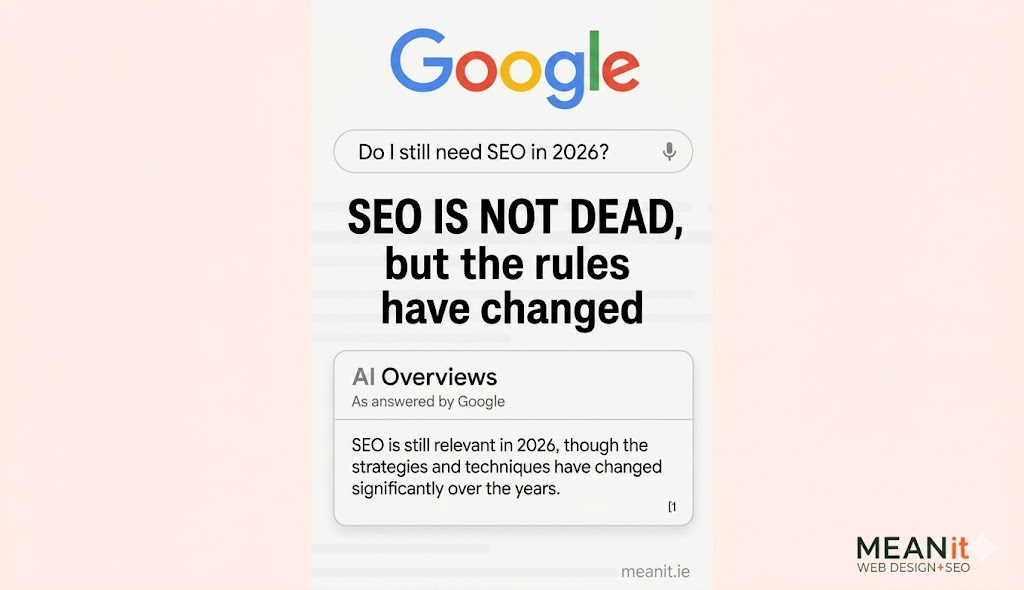
SEO is not dead – but the rules have changed. It is smarter now, so it is very different. SEO is in Googles ‘Oxygen Tent’ and Google makes all the rules. SEO still depends on Googles rules. AI and new LLMs are a very small part of search, so we still want to focus on the lions share of the traffic which is at Google. Ignore the hype about ChatGPT search, as it uses Google anyway.

Make sure your website is ready. Run a few tests. Check your current ranking in an Incognito window.

‘SEO is not dead, it is in Googles oxygen tent’

Googles introduction of AI overviews certainly made traditional SEO more challenging, as did the Helpful Content Update. But people will still use Google search and most do. Anyone in the small minority who use Search GPT or any AI search tool will end up getting presented with the best answer to any given query, just like Google. Therefore the aim in SEO to proffer the best answer to any given query still stands. Create great content, present it well, make it as interesting as possible and Google will still rank it and deliver it. So will any AI search tools.
What is changing is the ability to manipulate Google or get pages to rank in the top 10 SERP results on page 1 of Google, which for the most part was a vanity metric anyway. Or was a way to drum up visitor numbers as a metric. Nowadays, you may need to be in the top 3 to turn up in AI overviews. At the end of the day people do not want traffic for traffic sake, so we still need to attract the ‘right’ traffic. And then use the content presented on the resulting page to convert a visitor to a lead or enquiry or buyer.
These evolutions in SEO will see irrelevant backlinks carry less and less value in the eyes of Google. Buying backlinks as a way to fool or manipulate Google is of less value and could even damage credibility, doing exactly the reverse of what was planned.
SEO is not dead, far from it, SEO is alive and well, protected in the ‘Oxygen Tent of Google’. Many good SEOs have felt frustrated by how Google would rank poor pages over good ones. But your time has come, where Google will get better at delivering the best response to any given query with less and less black hat manipulation. ‘SEO is Dead, Long live SEO’. Again ignore the hype about AISEO or GEO etc.

Google AI Overviews Frequently Asked Questions  

How can I tell if Google AI Overviews are reducing my website traffic?

Look for rising impressions and falling clicks in Google Search Console.

If you’re showing up in search results, but not getting the same amount of clicks, chances are Google’s new AI Overviews are answering the question before people reach your site. You may still rank #1, but AI is now appearing above you and possibly using your answer in the result, but without really crediting you.

We look for this kind of pattern in client reports every month – especially if you’re in financial, legal or construction sectors in Ireland.

Can my business benefit from being featured in an AI Overview?

Yes – it can boost brand visibility, even without a click.

If your content is authoritative, helpful, and specific, Google may pull it into their AI generated summary. This puts your business name or quote right at the top of search results.

It won’t always bring a visitor straight to your site, but it helps build trust and familiarity with your brand  which often leads to enquiries down the line.

Do I need to change my SEO strategy because of AIOs?

Yes , slightly. Focus more on expert, unique content that’s hard to summarise.

Keep doing the core SEO work, but shift your content to:

  • Show experience and opinion (not just facts)
  • Answer specific long-tail queries your ideal clients would typically ask
  • Include video, FAQs and tools that AI can’t easily summarise

➡️ We help clients adapt every month – this is where the real SEO wins are happening now. It is actually an opportunity.

Is SEO still worth doing now that AI is in Google search?

Absolutely. SEO isn’t dead  it’s just getting smarter.

Even with AI Overviews, people still search, compare and click. What’s changed is how you win their attention. It’s no longer just about ranking high, it’s about offering something AI can’t replace.

➡️ Good SEO now means real expertise, clear branding and content that offers more than just an answer.

About The Author

You may also Like…

What is SEO?

What is SEO?

What is SEO or Search Engine Optimisation – SEO is an acronym for “search engine optimisation”

read more