Responsive Websites - Response-able or Adaptive Mobile Design
Most sites are too big to deliver effectively on Thin Clients such as Smart Phones, so pick 4 or 5 important bits and have them appear on the smaller screen, stacked in the right order, in Adaptive Layouts to suit particular screen sizes.
 Many, so called, "Responsive" sites do not automatically deliver well in all the various formats. A lot more information can be delivered on a Desktop than on a Mobile phone or Tablet, so work with your designer and developer to ensure that logical information is delivered on the various screen sizes. Start with Mobile design in mind. What do your visitors want to see or do when they visit your website ?
A taxi company may have lots of photos of their fleet and their offices on the Desktop version, whereas for their Mobile version the main thing is the contact number. Someone who is mobile wants a taxi NOW, not the opportunity to read all about the Company History.
Many companies are encouraged to invest in a second site for mobile, but that means having to manage content for two sites instead of one. It means two domains for Google to index. Get a good web partner who will make your site deliver well on all devices, showing the best content for each. Get the Developer to agree a maintenamce contract to keep the site sharp.
HOW TO MAKE A FAT SITE THIN
Most fat websites can be thinned and optimised to look well and get found in mobile search, so talk to your web team and get it done. Most templates or themes allow you dictate the Mobile look. Drop the size and number images and reduce the text, to tell people what you do, where you do it, who you are and how to contact you. Optimise the content for mobile search and use Special Offers to get people to sign up for text or email deals.
Have a Taxi firm - Number Number Number. Restaurant - Number, Offers, Availability, Location ? Dentist - Number, Make an appointment. Doctor or Medical Centre - Instant chat, Number ? Football Club - Fixtures List and Results or updates. Figures show that, even when a laptop is available people will still use their mobile to do their initial search. So, again, start with mobile in mind. This is where the future lies, as more and more people use smartphones.
For new websites, design it firstly with mobile in mind, as it is fast becoming the most important source of visitors, looking for something right now, information, news, offers, booking etc. Try telling your story on a 4 inch by 3 inch screen.
Mobile Website Design
 Most fat websites can be thinned and optimised to deliver fast, look well and get found in mobile search, so talk to your web team and get it done. Most newer templates or themes allow you dictate the Mobile look. The screen is smaller, so yes, it is more of a challenge for your designer, especially with Mobile eCommerce sites. Check out your Developers previous sites to see how well they work in mobile view and how fast they deliver pages - use PageSpeed Insights.
For new websites, design it with mobile in mind, as it is fast becoming the most important source of visitors, looking for something right now, information, news, offers, booking etc. Start with the mobile view and design backwards for tablet and desktop, maybe use icons for Calls to Action, rather than just navigation menus.
Images need to be sized differently for the various views, so they deliver as required, but staying as small as possible. Optimise them and only use them if they add to the message. You just want to let people know who you are, what problem you resolve and how they can get in touch with you.
Google Ranking Algorithm for mobile websites from April 21st 2015
"Mobilegeddon" - From April 21st 2015 Google added weight to rankings for mobile sites. Therefore we all need a Responsive website. Use their FREE tool here to see if your website is mobile friendly. Google were sending out emails to tell Webmasters that their site has mobile issues - fair warning. Google Analytics will also allow you see how many visitors go to your site via a mobile, probably 60%, so you can see how important it is for you. If you do not study your Google Analytics, you are missing a great resource. Get your head around this FREE report. Also check out this Guide from Google to get more answers and advice. Use Webmaster Guidelines to ensure your site is in good shape.
Adaptive Layouts will work well for smaller websites and deliver fast, but bigger sites will need good Responsive looks in multiple screen sizes. Good Responsive design will deliver in all screen sizes across all browsers, but it takes more time and money to get it right. With Adaptive, every new screen size that is launched means you need to add a further layout, so more time & cost, whereas good Responsive design will just shrink to fit screen. Talk to your web partner about which is best for you at present and most cost efficient.
Check your website or websites every week to ensure that your Contact and Call to Action items are all working. Your website needs to be checked every day to see that everything is working and in all browsers and screens. It is just like having a store on the High Street it needs to be kept tidy and spruced up. For Mobile SEO check out this Google Guide.
Any questions email Michael MacGinty at MeanIT
How do I make my existing website responsive ?
Technology moves on and that move gets faster and faster, so websites alwaays need attention. If your website is not responsive, it may need a theme upgrade which may also means other updates to versions or plugins. A bad mobile experience will chase visitors away.
If you have an open source CMS such as Joomla or WordPress, your web partner can do the updates from version to version. get a quote for the time required. It might be time to consider a redesign, to make the site more pertinent. Any site which is not converting is not delivering, so invest in better design, study your analytics and conversion rate, tweak the Calls to Action and work on it until you improve conversion. Imagine if you had a bricks and mortar shop where 10 people a day walked through the front door and then immediately walked back out again - what would you do?
Any older site that has not been maintained may not be worth updating, if it has bugs, trojans or other issues. Some platforms are easier to update than others. Always get a quote or estimate for the work to be done, but do accept that it has got to be done. It is not your developers fault that sites require updates. Some lower cost platforms such as Wix do not really offer good responsive options. Indeed if you have a basic HTML website, there will be challenges to making it very responsive. Also, some developers may find it a challenge with platforms such as Adobe Muse or Business Catalyst where the developer really needs to know their way around the platform. Many website suppliers are not qualified competent developers or coders, they just put up a WordPress or Joomla or Adobe theme, add some images and text, then say there is your website, but when you need serious coding done they are flummoxed. This is why so many give up and why so many people fall out with their website provider. The truth is that most websites do not deliver results and over 60% are not responsive.
Do I really have to make my website Responsive ?
Yes. In a word yes. Because 60% of people who browse the web use a mobile at least part of the time. Just accept that you need to do it, like you have to get your car serviced regularly, so that it works well. Then start looking at location based marketing in conjunction with your mobile plan. Everybody is using mobile, or will use it, as it makes sense to have a hand held multi purpose tool, to connect on social, browse or go shopping, control household technology or even to make calls. Siri or other voice activated options will make this remote control more more effective and personalised.
**** MOBILE BROWSING STATS
 Over 70% of buying decisions are made online, even if the purchase is doine in store or over the phone after a conversation or even in the store. In America over 90% of people use smartphones for local search, so this makes mobile frienndly websites critical. And over 75% of searches are done at home where there is probably a bigger computer nearby. Mobile is the initial handy tool people use to search nowadays.
MOBILE FRIENDLINESS WILL GET PRIORITY IN SEARCH RESULTS
What will be bad ? Text size too small, content wider than page, poor length of Navs, spacing of links, mobile viewport not set, 3rd Party plugins that are not friendly or general confusion in the layout. Google will see when visitors just bounce away and will punish poor sites.
 It is all about making the experience good for the browser, so how the page looks on a mobile. If there is a shop, how does it look and flow. Test your website here - it is a simple test that will tell you if your website is mobile friendly - easy peasy. You will get some results and actions to follow up. Read the fundamentals here or ask your Developer to do it.
Any site should be easy to navigate, whether that is on a pc, laptop, tablet, mobile or phablet, in any browser and at any time. That means work for someone, but if you want results you will need to comply and the bottom line is that this all good for your business, if you do it and bad for your competitor if they do not. There will be winners and losers - where do you come in?
Chances are that your website is not fully mobile friendly and you will need to do some work. Being mobile responsive is not enough, it needs to be mobile response-able where you can have the mobile view different to the pc view or the tablet view, so you improve navigation in a small screen.
SHOP FRONT FOR MOBILE ECOMMERCE
 Mobile is the new front door to your store. According to Google 75% of shoppers start with a small screen and when they are interested or engaged enough, they work their way to the large screen. As the mobile e-commerce interface gets better over the next few years, people will visit the store on their mobile phone and make the purchase securely on the mobile phone. According to Google, their local search is helping increase sales and traffic to local stores online presence, with nearly 20% of the searches leading to a sale. According to Google 80% of shoppers start with a mobile phone, when they go window shopping digitally.
Also, according to Google, if you can state or prove online that you have the stock physically in the store, then mobile viewers are likely to go there to try it on, have a look at it, kick it, test it and buy it. Even when they are in store, shoppers say they compare prices using their mobile phone by looking up the same product in other stores to get the best pricing. They may leave a store to go to the lower cost location, if the price is more than 5% lower.
One very important aspect of Googles research is their finding that customers, who buy once from a particular store or brand and have a good experience, are likely to keep coming back to the familiarity of your website and are supposedly worth 10 times more than any other one off customer. We are all using our smart phone to research everything we do, so all of this should be really obvious for retailers, whether they are mainly online or mainly off-line.
MOBILE ECOMMERCE FUTURE TRENDS
As the technology and security improves, online e-commerce stores will be able to identify people, who are browsing by age, sex and location and deliver a variety of results in their website interface, based on that information. Whether you are a teen or a thirty-something or even a silver surfer, soon smart website solutions will deliver a user experience that suits you and your particular needs or preferences.
Mobile is really starting to take off in a serious way for e-commerce and as secure mobile payment systems are added, alongside the forthcoming simple easy carts and check outs, online sales can only continue to grow. Clumsy forms will be replaced by using simple bio metrics and voice recognition technology. Much like using social in your marketing mix today, your mobile presence will dramatically affect your ability to sell anything tomorrow.
Warning - mobile eCommerce threat.
Even the systems that are being offered by web development companies today, will not be good enough for e-commerce tomorrow. Your digital engagement in Mobile needs to be radically rethought, redesigned, restructured and redeveloped ASAP. Otherwise, new tech savvy operators will appear and take a chunk of your market, simply because they understand and use the tools that your customers want to use. This is not rocket science, people stopped sending telegrams when they started using telephones. If you are in the business of selling anything, put a date in your diary with your marketing team to discuss how you are going to change your approach and your digital platforms to engage your audience and convert them to buying whatever it is you are selling. This engagement has to start online to get them to go to your store whether you sell online of offline.
The Good News
 If you are willing to embrace these new and ever evolving technologies, you have a great opportunity to grab a chunk of someones market and create a space for youself. To be honest, standing still was never an option in business. Google explains that the Micro Moments as they call them are our chance to connect and deliver timely results, if we get the interface right for our visitors. When people have a problem or a question, they reach for the phone, as the first port of call for an answer. It is the Zero Moment Of Truth. In 2017 Google reported that people now expect to be able to search on their phone, find the right answers, ones that are specific to their own geographic location and if all this is working they will buy online using that phone. In the past two years people have become comfortable with browsing on their mobile phone, getting the answers they want and are trusting enough to order online. The fear factor of 2015 is gone, so if you can answer a need through a good responsive website, at a fast speed, then you can sell through that small screen. If you can appease that sense of impatience, deliver the required speed and make the buying process simple, then you are way ahead of your competition - for now.
Google Micro Moments
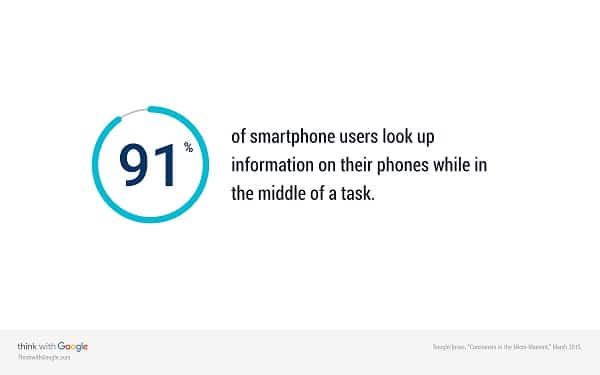
Googles Micro Moments - If you have not already heard reference to Google and Micro-Moments, it refers to that point in time when someone has a need and does a search, especially when they turn to their smartphones when they want to know something, go somewhere, do something and buy something. This is the new norm in a mobile-first world as Google refers to it, that single point in time when someone wants an answer to a question, so they do a Google search.
A lot of research is going in to this, because search will work best if the correct answers can be delivered quickly, with the most up to date relevant information. Google always aims to be the number one choice for search.
For companies who advertise we are advised to consider this too. How do I get tickets for the 6 Nations? Where can I get a tyre repaired in Galway? Best solicitor in Donegal? Obvious questions that need simple answers. It may seem basic, but try doing a search where you ask a question which brings up a page from your website. If you ask the sort of question that a potential customer is likely to ask, why do you not come up on Page 1? And if you are on Page 1 what happens when you get a click? Do you get a new customer, make a sale, get a new subscriber? Google did a slot of research around what it calls the ZMOT or Zero Moment of Truth. The research highlighted the fact that the old way of advertising and getting a reaction is less effective, because people search for what they want rather than what is being advertised. This can dilute the effect of advertising as we know it and certainly means that people can find answers when they want them as opposed to when they are faced with advertising.
Again, for some people, especially younger people, this may seem like common sense, but the way companies have advertised in the past, means that they are slow to change, to adapt to a new digital landscape, a mobile-first environment, where a smartphone is assisting with answers to every question, anything that people want to know, go, do or buy. The old way of getting to the moment of truth, to the buying decision was to advertise to create a stimulus to buy, whereas now shoppers research what they want to know, where they want to go, what they want to do or what they want to buy. Typically a shopper might look at 10 to 14 sources of information before deciding to buy. You want to be there when they decide to buy, so offer more than just products, offer advice, help, guides and show testimonials, case studies, before and after images etc. In the olden days the advertisement was the first moment of truth, the second was when someone saw the advertised product in a store and bought it to try and finally the third moment of truth was when the buyer liked what they sampled and was 'converted' to that product.
Nowadays people probably start searching without stating their geographic location, so you need to be found without that extra detail being in the search term. Search web design donegal and we will be number 1, but search web design when you are in Donegal and the result will depend on where Google sees your IP address as being which could be an Eircom server in Carlow or a Vodafone server in Belfast. This IP problem where a visitor is not defined correctly geographically is a complex issue which threatens retailers especially in the smaller towns.